Sunday, July 30, 2017

The Confessional: Sex and the Single Girl

Confession is one of the best known sacraments of the Catholic Church. Though this is not a religious blog, per se, movies are certainly my religion of choice. Therefore, I have decided to embark on a new series to be used as often the mood strikes me. In The Confessional, I will discuss certain movies that I have come to embrace for strictly personal reasons. These movies are my guilty pleasures--ones I find entertaining, enlightening, and/or just plain fun that critics, scholars, and historians have neglected, forgotten, or perhaps never even seen. I hope you will allow me this indulgence. 

One of my first great memories of watching movies on television is the night my older sister and I stayed up late on a Saturday to watch Natalie Wood and Tony Curtis in the comedy, Sex and the Single Girl. We laughed and laughed at Henry Fonda and Lauren Bacall's funny dance (they were doing the Twist) in which nothing but their arms seemed to move; Larry Storch's bewildered CHP ("My motorcycle. My motorcycle!"); Rudy, Mel Ferrer's exasperating, shallow, wannabe gigolo co-worker of Wood's Dr. Helen Gurley Brown ("Oh, shut up, Rudy!"), and a myriad of other scene stealers. Coming home from a night out, my parents couldn't figure out what my sister and I found so amusing.

Poster art for the film

If I remember correctly, I saw the movie for the first time in the late 1960s when it was just a few years old. I'm sure it was my sister's idea to watch the movie; at ten, I was far too young to appreciate the finer points of pretty much any movie. Not that SatSG has finer points. The movie was a kind of mid-Sixties screwball comedy disguised as a sex romp before the sexual revolution took place. By today's standards, it is more than a little bit innocent (or, you know, retrograde) in its attitude toward its titular subjects.

After supposedly saving his life, Natalie Wood's Helen Brown brings Curtis' Bob Weston
back to her place to dry off in one of the film's sexiest scenes.

A little background: Sex and the Single Girl was a non-fiction, self-help book written by Helen Gurley Brown. Originally published in 1962, the book attempted to aid single girls who wish to explore the world, including being single, having a career, and sex without marriage. Brown's book tried to show single women that a life alternative to the standard one of love and marriage might be both possible and preferable.

Sex and the Single Girl, the book, was a bestseller, but when Warner Brothers acquired the film rights, the studio had no idea how to adapt it for the screen. Ultimately, Warners kept only the book's title and its author's name for the main character. The rest of it went in the trash can. The studio had to make something (fictional--a documentary wasn't even considered) out of nothing, so why not a sex farce? Push convention as far as the early 1960s would allow, mix the ingredients, throw it against the wall, and see what stuck.

Bob Weston, playboy extraordinaire, listens as his next door neighbor,
Frank Broderick (Henry Fonda), pours out his marital grief. 

What stuck was a sexy, occasionally raunchy, chauvinistic time capsule that was popular enough with audiences to land the film on Variety's list of the top twenty highest grossing movies of 1964. Though not popular today--seldom even remembered--Sex and the Single Girl does, indeed, transport me to a time when women in movies were still called girls (which never fails to knock me sideways), and the old (wink, wink) it's-ok-for-men-to-fool-around-but-women-cannot-even-look-at-a-man double standard still applied. The early-to-mid Sixties were rife with these kind of films, usually brought to America's movie screens with Doris Day, Rock Hudson, Sandra Dee, Cary Grant, Jack Lemmon, and Debbie Reynolds, among others. Some had a genuine wit or point of view (Some Like It Hot, The Apartment) or were disguised as something other than they were (How to Murder Your WifeBreakfast at Tiffany's), yet they all amounted to the same thing: the virgin will not become a nun ... or stay single.


In spite of its deep roots in traditional boy-meets-girl storytelling, Sex and the Single Girl was ahead of its time in some respects. After all, Sex and the City basically navigated the same terrain thirty-plus years later, albeit with a more contemporary (i.e., liberated) perspective. Appreciation of Sex and the Single Girl may depend on the viewer's frame of mind. When I first saw it, the storyline of a hack journalist setting out to expose the virginity of a sex therapist was titillating to me in the extreme. No matter how tame it looks today, there is a pretty frisky scene in the film in which Wood and Curtis turn down the lights while clothed only in revealing robes. Racy!


The movie plays out a veritable potpourri of mid-Sixties angst and cultural cliches. Tony Curtis's playboy character, Bob Weston, writes for STOP, a "filthy rag" of a magazine run almost exclusively by white, middle-aged-to-old men (fact is, Curtis seems the youngest, and he was nearly forty at the time). The clinic where Natalie Wood's Dr. Helen Gurley Brown works is as sexist as the STOP staff. And Bob's neighbors, Frank and Sylvia Broderick (he's a sad sack; she's a shrew), hilariously played by Henry Fonda and Lauren Bacall, are crazy for each other yet do nothing but fight. When I watch the movie now, it's hard not to believe in that notion of the early Sixties as a more innocent time. I take joy in its extremely simple pleasures--broad comic farce played by an expert cast, the suggestion that a naked back is as sexy as a naked front, and a resolution in which they all live happily ever after.

If only life could be like this. <sigh>

Sunday, July 16, 2017

Crush of the Week: Carroll Baker

She turned 86 on May 28, 2017. That sounds awfully old for an actress whose film persona oozed sex. But however brief her reign, Carroll Baker was the mid-Sixties answer to the vacuum left by Marilyn Monroe's death.

Baker as Jean Harlow in the 1965 film Harlow:
The film pretty much ended her career in Hollywood.

Before her career went the route of sex, cheesecake, and Playboy photo shoots, playing Jean Harlow wannabes in movies like The Carpetbaggers and a version of the real Harlow in the 1965 film of the same name, Carroll Baker was a talented actress. A product of New York's Actor's Studio, Baker's film debut came in an Esther Williams movie called Easy to Love in 1953. 1956 was Baker's breakout year with two films both regarded as classics: George Stevens' sprawling rendering of Edna Ferber's epic novel of Texas oil and cattle, Giant, and Elia Kazan's take on Tennessee Williams' seamy, steamy Baby Doll, with Ms. Baker in the title role as Karl Malden's child bride.

Amazing billboard at New York City's Astor Theater


Giant was one of 1956's most anticipated movies after the recent death of its star, James Dean. Giant is a huge film, sprawling and not quite certain of whether it wants to be a love story or a social drama about class distinction and racial equality. Baker plays Luz Benedict II, the oldest daughter of Bick and Leslie Benedict as played by Rock Hudson and Elizabeth Taylor (her brother is played by future biker and wild man, Dennis Hopper. Some family!). Baker's Luz falls hard for Dean's Jett Rink, an all-around scoundrel, whose real love for Taylor's Leslie is unrequited. A scene between Baker and Dean--a favorite of mine--takes place in his new hotel shortly before its grand opening. Dean's Jett--by now an alcoholic mess--proposes marriage, which Baker's Luz gently talks him out of.

Carroll Baker's other film that year--the one that sealed her cinematic fate--was Kazan's Baby Doll. Based on Tennessee Williams' play 27 Wagons Full of Cotton, Baby Doll was condemned upon release by the Catholic Church. The film is a comically absurd yet extremely suggestive study of misogyny and greed. From scene one, Baker nearly dominates the screen as Baby Doll, more than keeping pace with the masterful work of her co-stars, Eli Wallach and Karl Malden. Malden--always good--brings the ignorance and lust of Baby Doll's husband, Archie, front and center.

Carroll Baker in the nightie that gave birth to the term "Baby Doll."


Carroll Baker does an terrific job as the flirtatious yet virginal Baby Doll. Whether parading around in her short,"babydoll" nightgown or eating an ice cream cone in the back seat of a convertible, Baby Doll appears aware of her sexuality, yet maintains an innocence as she remains ignorant of the lust she generates in the entire male population of her Mississippi town. The eroticism of Baker's scenes with Archie's rival, Silva Vacarro (Eli Wallach), is intense even sixty-plus years removed. It's a wonder the film got made at all. Baby Doll was the scandalous movie of its day, though still classy enough to gain four Oscar nominations: Carroll Baker for Best Actress, Mildred Dunnock for Best Supporting Actress (as Aunt Rose Comfort), Tennessee Williams for Best Screenplay, and Boris Kaufman for his magnificent cinematography.

Under contract to Warner Bros., after Baby Doll Baker declined the part of Diana Barrymore in Too Much, Too Soon and went on suspension, missing out on MGM's version of The Brothers Karamazov. The Warner's contract also prevented Baker from making MGM's Cat on a Hot Tin Roof and The Three Faces of Eve at Fox. Clearly her contract was holding her back.

When the suspension was lifted Baker made The Big Country. Directed by William Wyler, this 1958 western is often overlooked when great films of that genre are discussed, but the film is a good one and a big one. Starring Gregory Peck, Jean Simmons, Charlton Heston, and Burl Ives in a Best Supporting Actor Oscar-winning role, it did well at the box office. Baker is good as Patricia Terrill, a woman completely different from Baby Doll.

Owing Warner's one more film on her contract, after The Big Country, Baker played in The Miracle. Then she moved across town to Paramount for a comedy with the "King," Clark Gable, But Not For Me, an enjoyable film, after which she found herself in a film as controversial as Baby Doll.

1961's Something Wild was directed by Baker's then-husband, Jack Garfein. Financed by Baker and Garfein, Something Wild was meant to prove to Hollywood that Garfein was a top flight filmmaker and get Baker's career as a serious actress back on the track. Unfortunately, it nearly ruined it.

Something Wild tells the story of Mary Ann (Baker), a college student who is brutally raped one night while walking home from school, and the effect the rape has on her psyche. Traumatized, a suicidal Mary Ann is stopped from jumping off a bridge by Mike (Ralph Meeker), a lonely auto mechanic. Sympathetic, he takes her back to his small apartment, tells her to stay until she feels ready to go home, and leaves. He comes back several hours later, drunk, and makes stumbling advances, grabbing her. Fighting back she kicks him and hits him in the face, but he will not let her leave. Mike asks her to marry him, but she refuses. Though Mary Ann manages to escape one day when Mike leaves the door unlocked, after wandering the city and sleeping in Central Park, she returns to Mike.

Baker as a rape victim in the independently made Something Wild, 1961

The film got mixed notices from critics and a cold shoulder from filmgoers. Something Wild was ignored for years before a small cult surged around the film, started by bloggers like me. Seen today the film plays ambiguously. Its tone is mysterious, and its subject is disturbing even by today's standards. Its technical work anticipates the ground-breaking work to come later in the Sixties and into the Seventies with much location work in New York City. But the film's failure pushed Baker back to Hollywood with its mega-watt stars and big budget features.  


Baker, Debbie Reynolds, Karl Malden, and Agnes Moorhead
in the epic How The West Was Won, 1962

First up was 1962's How The West Was Won. Filmed in Cinerama and top lined with heavy hitting stars like John Wayne, James Stewart, Henry Fonda, Gregory Peck, Debbie Reynolds, and Richard Widmark, HTWWW is an entertaining (yet not always accurate) ride through the history of the American West. The film is broken up into five sections: The Rivers, 1839; The Plains, 1851; The Civil War, 1861-1865; The Railroad, 1868; and The Outlaws, 1889. More important for Baker was the movie's huge box office, making nearly $50 million worldwide and giving her the biggest success since her Giant days. Next came the movie, which I will forever associate with Ms. Baker, 1964's frolic, The Carpetbaggers.

The chandelier scene from 1964's The Carpetbaggers

In 1964, I was five years old. In my young brain, Carroll Baker was (suddenly) the naughtiest woman I had ever seen. And it is with this film that her sex symbol status is reinforced, though the Carroll Baker of 1964 was not the same woman as Carroll Baker of 1956. She had matured into an even more beautiful woman. I don't know when The Carpetbaggers was first shown on network television, but when it did, I was watching it in our family room, probably sitting on the shag carpet, eating popcorn, and wondering what it was all about. I didn't know a a thing about Alan Ladd, who played Nevada Smith a.k.a., Max Sand, or George Peppard who played Jonas Cord (based--very loosely--on Howard Hughes), but I sure as hell thought I knew what Ms. Baker as Rina Marlowe (supposedly based on Jean Harlow) was up to when she was scantily clad on top of the chandelier or rolling around on a bed telling Peppard to "love me, Jonas, love me!"

The Carpetbaggers was the biggest financial success of 1964 ($28 million gross in US) and became one of those bad-movies-I-love, a camp classic alongside 1967's so-bad-it's-good Valley of the Dolls. The result of all this box office gold was a boon to Ms. Baker's career as an international sex symbol. After the death of Marilyn Monroe in 1962, audiences and press were on the lookout for the next blonde bombshell, and Baker was the first flavor of the month to appear. Unleashed on the American public in the spring of 1964, the film pushed the censors of the day about as far as they could go, including a brief nude scene with Ms. Baker.

Baker embraces a young Indian girl in John Ford's swan song to
the American West, Cheyenne Autumn. Dolores Del Rio is on the left.

John Ford's Cheyenne Autumn was the great director's swan song to the western form he loved so much, and also served as his tribute to the American Indian, which he has been accused of misrepresenting in previous films. Based on actual events, the film about 300 starved and weary Cheyennes trek from their reservation in Oklahoma territory back to their home in Wyoming takes Baker, who plays a Quaker school teacher, about as far from the sleazy world of Harold Robbins as possible. Baker's subsequent films were The Greatest Story Ever Told,  George Stevens' ponderous take on the life of Christ, in which she had a cameo; Sylvia, a drama with Peter Lawford, Aldo Ray, Joanne Dru, and Edmund O'Brien with Baker as a scheming prostitute; the entertaining yet hard to find Mister Moses with the always watchable Robert Mitchum as a con man trying to convince an African tribe to relocate for their own safety; and Harlow, a biopic very loosely based on a book about the first blonde bombshell, Jean Harlow. A movie that blatantly disregarded the facts, Harlow is true trash, albeit with a good cast (Red Buttons, Peter Lawford, Angela Lansbury, Martin Balsam), that brought Baker back to the land of The Carpetbaggers (i.e., sex, sin, and scandal). This time out, however, the film did poor business.


This post-Carpetbaggers flurry of failures effectively ended Baker's career in Hollywood. In the late Sixties, Baker relocated to Italy where she made a slew of thrillers with names like Orgasmo; The Sweet Body of Deborah; So Sweet ... So Perverse; and Her Harem. In June 1969, The New York Times published the article titled, "Whatever Happened to Baby Doll?," which sums up what audiences in America were wondering. Her European stay, which lasted about ten years, did bring financial stability for the actress, whose films were successful there but got limited bookings in the States. In 1977, Baker returned stateside in Andy Warhol's Bad as the owner of a beauty shop who makes extra money by operating a murder-for-hire side business.

Baker in 1969's The Sweet Body of Deborah, one of her many European films
that got limited playing in American theaters

Back in the US, Baker made the low budget The Sky is Falling, reuniting with her Giant co-star, Dennis Hopper, who was also in the career doldrums. Baker also appeared in stage productions of Bell, Book and Candle; W. Somerset Maugham's Rain; and Lucy Crown, which was based on a story by Irwin Shaw. Divorced from Jack Garfein in 1969, Baker married for a third time in 1978 to British actor, Donald Burton. During the 1980s Baker began her long career as a character actress in films, including The Watcher in the Woods opposite Bette Davis; Bob Fosse's last film, 1983's Star 80, about the brief, tragic life of Playboy centerfold and budding actress Dorothy Stratten; Ironweed with Jack Nicholson and Meryl Streep; and Kindergarten Cop, a big money-spinner starring former bodybuilder and future California governor, Arnold Schwarzenegger. Baker remained busy in television as well, appearing in Murder, She Wrote and L.A. Law, among other series. Her final film was 2000's Another Woman's Husband. I haven't seen much of her post-Sixties work, but I will always be grateful to Carroll Baker's Rina Marlowe, a performance that taught me what sex symbols are all about.


Sources : IMDB
                Wikipedia
                 Baby Doll : An Autobiography by Carroll Baker
                Images courtesy of the Internet
                Baby, I Don't Care by Lee Server

Monday, July 3, 2017

Hollywood's Endless Bummer

Ok, so, this is a letter of complaint. In my long, long history of movie-going, I don't think I've seen the likes of the box office--much less creative--returns from the summer's "blockbusters" since ... well, actually I can't think of a worse time to be an avid moviegoer.

Another in an unending number of Alien sequels

Hollywood, running itself into the ground out of an intense fear of failure, is giving us tent pole sequels and pre-fab titles like Baywatch, which was neither an extraordinary--or even mediocre--television show. Baywatch the movie has suffered a worse fate. It was dead on arrival, one of 2017 summer movie season's many casualties. I have to ask the question: Who the f*** are running these studios? Why oh why can't these Hollywood movie conglomerates remove their heads from their backsides and come up with something worthwhile? Remakes, retreads, reboots, sequels, prequels, and rip-offs dominate and strangle our cinema screens. Turning back the clock seems to be the go-to action rather than actual creativity.

Does this poster really make you want to see this movie?

There are many, many, many things wrong with Hollywood and its movies today, and one of the biggest flaws is the advertising. I mean, the Baywatch movie was DOA anyway, but its poster doesn't do it any favors. Other movies this season include a reboot of The Mummy franchise, Universal Pictures' effort to relaunch its classic horror icon. When I heard about this project, I questioned its validity. I mean, why make another Mummy movie? I understand that Universal has a strategy to remake its classic monster movies, bringing them up to date with the best CGI money can buy and signing a big, big star. With that combo who needs a original script? Well, I guess John Q. Public decided he did. The Mummy was budgeted at $125 million. As of this past weekend the film's has grossed about $75 million in the USA. Not exactly overwhelming box offices numbers.

Screen capture from the original 1932 version  of The Mummy

Poster for The Mummy, 2017
Compare this with the previous picture and tell me which one looks creepier.


All of this isn't new. Many critics have voiced this opinion before: Hollywood is creatively barren, especially when it comes to the summer movie season. There was a time when summer movie fare wasn't all sequels, comic books, and special effects. But something happened in the past twenty or thirty  years. Success is one of the curses of the film business: Hollywood always thinks it can create, capture, seal, and maintain lighting in a bottle. But Hollywood is most exciting when a movie that no one thought would amount to much defies the odds and becomes a huge hit. Star Wars did it. So did Jaws. Home Alone is another example. The Matrix was unleashed without its own studio knowing the impact it would make. Like them or loathe them, these movies became box office record breakers, and they were all surprise hits. Even James Cameron's Titanic was predicted to flop due to its enormous cost. Yet the film became a phenomenon that millions went to see over and over again. And that leads me to another gripe I have with Hollywood: tracking box office returns.


Websites such as Box Office Mojo as well as more traditional sites like Variety report on the weekly returns of Hollywood's latest movie releases. However, these organizations routinely post results on a movie's gross intake. That is misleading. True box office success is the return on investment to the studio producing a movie. In other words, box office success is not about grosses but about rentals, and they account for about half a film's box office intake. Rentals are what the studios get back after theaters take their share. Gross doesn't mean anything. When The Godfather became an all-time box office success, it was a movie's rentals that was the standard, and that figure was approximately $100 million (around 500 million in 2017 dollars) in 1972-73. And that was only in North America. How many films today can make that claim? Today's movies--especially summer movies--are like television reruns. Alien: Convenant; Spider-Man: Homecoming; The Mummy; Pirates of the Carribean: Dead Men Tell No Tales; Transformers: The Last Knight; Cars 3; Despicable Me 3; and on and on. Of course, there are a few adult-themed films out there (My Cousin Rachel and The Beguiled, for example), but these movies are pushed so far under the radar that it's difficult even to find them in smaller markets. High quality as they may be, these movies get almost no publicity and are not tracked by programs like Entertainment Tonight due to their small theatrical roll out (around 750 screens versus 2,000-3,000 screens for the upcoming Spider-Man release). Consequently, the public is not aware these films are even out there.

With all this said, it's not just the major film studios that catch the brunt of my disdain. A good portion of it must go to today's movie-going public. People don't want to see something good--something that moves them, makes them laugh or cry. What was the last romantic comedy--once a staple of filmmaking--you saw? Was it any good? I cannot remember one. To me, it seems folks don't want to be surprised by the emotions a good movie may generate. It's like a mantra: give us the familiar s*** that we have seen over and over again. Reruns.


Any era in which The Rock is the country's number one box office draw is in trouble. Can anyone remember a line of dialogue from any movie of the past five years? Nothing like, "We're gonna need a bigger boat" or "Go ahead, make my day" or "I'm gonna make him an offer he can't refuse" or "Forget it, Jake. It's Chinatown." No? Me neither. Now I hear Paramount is moving forward with a sequel to (cue sarcasm) that all-time great movie, Top Gun. Is this what America and countries around the globe want? This latest example of Hollywood's creative bankruptcy is due to explode (like a bomb?) into your local cinemas in July 2019. Gee, I can hardly wait.

Sunday, March 19, 2017

"Tell Mama..... Tell Mama All": The Doomed Love of George Stevens' A Place in the Sun


Greatness is a slippery slope, especially when it comes to film. Movies that are praised upon first release can seem static and dated ten years on. That is often why films that win the Academy Award for Best Picture are often seen as poor choices later while other, less praised films are deemed more significant later on. Then there are films that are praised for their craftsmanship, emotional impact, and artistic value from their inception, and whose reputation continues to grow. Successful films often capture lightning in a bottle. In 1951, director George Stevens made A Place in the Sun, a film that caught the post-World War II malaise, desire, ambition, and desperation better than any film of its time.

"Don't do anything hasty."
Angela's father gives his advice to his daughter and her lover.

Based on the novel An American Tragedy by Theodore Dreiser, A Place in the Sun tells of George Eastman (Montgomery Clift), a working-class young man whose mother is dedicated to mission work for the poor and homeless. George, hard working but ambitious, hitchhikes from Chicago to go to work for his rich uncle, Charles Eastman, in his swimsuit factory. It's there George meets a lonely soul, the plain-looking Alice Tripp (Shelley Winters). The two begin to date--against company policy. During a plant inspection, Charles sees George toiling on the assembly line and decides to kick him up a rung in the factory. Invited to a party his uncle is throwing, George meets and is immediately smitten with Eastman family friend and socialite, Angela Vickers (Elizabeth Taylor). But complications arise when Alice discovers that she's pregnant with George's child. George, not wanting to lose Angela, wants to do right by Alice but wishes she'd just go away. Tragedy ensues.

The lonely people: George and Alice, before he meets Angela.

The Paramount Pictures' release was critically praised from the moment it hit America's screens in August 1951, and when the Academy of Motion Pictures Arts and Sciences announced its nominees, A Place in the Sun received nine nominations, second only to Elia Kazan's A Streetcar Named Desire. Among its nominations were Clift for Best Actor, Winters for Best Actress, Stevens for Direction, Michael Wilson and Harry Brown for Screenplay, and the film for Best Picture. Place won in six of its nominated categories, losing Actor to Humphrey Bogart in The African Queen and Actress to Vivien Leigh in Streetcar. The biggest surprise of Oscar night 1952, however, was An American in Paris' win for Best Picture. Experts picked either Place or Streetcar to take the top prize, but Oscar had other plans. Obviously the 1951 films were a superior group, and tough choices had to be made, but I think Oscar fumbled when the Best Picture award was handed out. Much as I enjoy and admire Vincente Minnelli's musical, A Place in the Sun or A Streetcar Named Desire should have won. Only seven times in 89 years has a film won for screenwriting and direction while losing Best Picture as A Place in the Sun did (including, most recently, in 2002 when The Pianist took Screenplay and Director while Chicago won Picture).

The beauty of a young Elizabeth Taylor:
"Being exclusive? Being aloof? Being blue?"

Despite the questionable results at the Academy Awards, A Place in the Sun is widely acknowledged as a superior film and is still remembered for the doomed love played out by Montgomery Clift and Elizabeth Taylor. Their scenes crackle with sexual energy and romantic longing. Hyperbole aside, they may be the most romantic couple in cinema history. Like many great movie romances, George and Angela are not together at the film's conclusion, which is significant. Think of all the great love stories in film history--Scarlett and Rhett in Gone With the Wind, Rick and Ilsa in Casablanca, Norman Maine and Vicki Lester from A Star is Born, Tony and Maria in West Side Story, Hubbell and Katie in The Way We Were. It's the tragic love, the doomed love that lives on in our collective memory. The couples that stay together tend to skew comedic: Nick and Nora Charles, innumerable Tracy and Hepburn pairings. Romantic comedy ends happily; romantic drama ends, if not tragic, at least sad. And the most tragic movie love of all may be George and Angela.

Before World War II, A Place in the Sun's director George Stevens was known as an expert in light comedy. Such films as his Oscar-nominated 1943 war-time laugh-fest, The More The Merrier; 1938's screwball classic, Vivacious Lady; the rousing adventure, Gunga Din; and possibly his best known pre-war hit, 1942's Woman of the Year, the film that first brought Spencer Tracy and Katharine Hepburn together. When the U.S. entered the war, Stevens was just one of the movies' greats who left a thriving career behind, joining the U.S. Army Signal Corps in 1943. What Stevens witnessed while in Europe changed his life and his art forever.  Stevens was one of the first to view the horrors of the Nazi concentration camp, Dachau. The pure evil Stevens saw altered his worldview and, consequently, the movies he made. Stevens, always a somewhat stoic character, became silent after the war, according to his fellow director, soldier, and friend, Frank Capra. His wife, Yvonne, said the same thing, adding that upon his return from the war, Stevens played golf, all day, for seven months. Stevens wasn't sure he would or could make another movie again; didn't know if he had a future in Hollywood. After re-gaining some enthusiasm with his adaptation of Broadway hit I Remember Mama, Stevens found the story he'd been looking for, one that reflected his somber, sullen view of post-war America: Dreiser's An American Tragedy, published in 1925 and based on a real incident in 1908.

George Stevens directing his two stars.

As the script evolved, Stevens slowly made the the film a romantic tale of false hopes and doomed love. According to Marilyn Ann Moss's fine biography of the director, Stevens skewed the story in George Eastman's favor by turning Shelley Winters' Alice into a shrew and and molding Taylor's Angela into a girl of fantastical beauty and romantic affection. Further empathy for George was generated via casting of Raymond Burr, then well-known for playing villains (and years away from his long-running gig as television's top lawyer Perry Mason), as the District Attorney eager to convict George of Alice's murder. With these elements plus Montgomery Clift's creation of a man whose life is being pulled out from under him, audiences are hard pressed not to be caught up in the romantic, tragic drama. 

One of the many scenes in which Elizabeth Taylor's
nurturing Angela holds Montgomery Clift's George in her arms.

The story goes that night before the famous love scene was filmed--the one that confirms George and Angela's passionate devotion--Stevens was up until two in the morning rewriting to give the scene the vitality it needed. Stevens knew it would be the centerpiece of the movie. If this scene didn't work, the movie would fall apart, so it had to be extraordinary. When Taylor saw the new pages the next morning, she balked, thinking the lines ludicrous. "Excuse me, but what the hell is this?" she demanded. Stevens later recalled Taylor's outrage, stating she was "jumping into a sophistication beyond her years" (Taylor was only seventeen when filming began in 1949). The scene itself is one of American cinema's finest examples of passion. Stevens smothering close-ups of the lovers makes the audience a voyeur, inappropriately invading the privacy of their unexpected, frantic, intoxicating romance.  "Are they watching us?" Taylor says suddenly as she turns toward the camera--nearly looking directly at it--before she practically pushes Clift onto the veranda and into their private moment. Both actors are marvelous in the scene, but Taylor especially owns it with the "[t]ell mama" line as well as her flirtation when telling Clift that they can have the whole summer together. Clift balks. Taylor says she could come and get him. Then she gives him a slight seductive smile and says, "You'll be my pick-up." It's an extraordinary moment.


As for Clift, it may be his best performance on screen, a list that includes four or five of the best performances ever captured on film. Clift's George Eastman is all hesitation and hunched uncertainty, a portrayal that seems like one of cinema's most blank of all time. Here is a man who is uncertain in everything he does. Witness his silence when riding in Taylor's car as she escorts him to the party at which they'll proclaim their great love for each other. It's only when Taylor coaxes it out of him that Clift can finally tell her how he feels about her. His emotion is like an overflowing river. This private love of two people is what I feel the film gets right. No one else can describe what two people--these two people--feel for each other. This is what still speaks to audiences. That sense of passion, of finding the one you love most in all the world, the feeling that you can never live without that person is what A Place in the Sun captures perfectly.

George in the boat with Alice, wishing her dead.

As for the actual crime in the film, it's shot far away. As the boat overturns, the camera cuts back to a long shot, with only the sound of the loons on the lake encroaching on the silence. The audience is  left to draw its own conclusions as to whether George actually killed Alice or only had his wish fulfilled by accident. Certainly George wishes Alice would disappear so that he can be with Angela and live his dream life, but does wish fulfillment make him a murderer? This is the great moral dilemma of the film. One of the beauties of A Place in the Sun is that the film allows us to draw our own conclusions. As for me, I think George is innocent of Alice's murder, and I don't blame him for wishing her dead. George has found his place in the sun, though it came at the greatest human cost--both Alice's life and his own. I don't think George really minded about his own life, though. If he couldn't have Angela and the love he dreamed of, he would rather be dead.

Passion.


Sources: Giant: George Stevens, A Life on Film by Marilyn Ann Moss
               Montgomery Clift: Beautiful Loser by Barney Hoskyns
               Montgomery Clift: A Biography by Patricia Bosworth

Saturday, November 26, 2016

Underrated Gem: Humoresque

"All my life I wanted to do the right thing. But it never worked out. I'm outside always looking in, feeling all the time I'm far away from home, and where home is I don't know. I can't get back to the simple, happy kid I use to be."  
--John Garfield's opening scene from Humoresque    

A devastated John Garfield after Joan Crawford's death:
the opening scene of Humoresque, 1946

In the early 1990s, I became infatuated with Oscar Levant. I'm not sure why, but I assume his wisecracking movie roles, especially in 1946's Humoresque, had a lot to do with it. This Warner Brothers movie--a kind of rip-off of Clifford Odets' (who co-wrote this film) Golden Boy--won me over the first time I saw it many, many years ago. The soapy film starred Joan Crawford as an alcoholic, married, society dame (as co-star, John Garfield's character refers to her) who has a fondness for--as Garfield's cynical sidekick Oscar Levant so aptly puts it--"la vie boheme." Joan Crawford, who had been released by Metro-Goldwyn-Mayer (MGM) studios in 1943 after nearly twenty years, was considered somewhat washed up in Hollywood by the mid-Forties but made a huge comeback in 1945 with Mildred Pierce, grossing millions for Warners and nabbing an Oscar for Best Actress of 1945. Humoresque was her follow up to that classic film.

John Garfield--second billed--was also hitting a career peak after the 1945 film, Pride of the Marines (another underrated gem), and the noir scorcher, The Postman Always Rings Twice, opposite Lana Turner. Here, Garfield plays Paul Boray, a Lower East Side kid with a talent for the fiddle. (The violin playing was dubbed by the great Isaac Stern, who also served as Garfield's hand double. The effect, still impressive some seventy years later, was achieved in the film by cutting the sleeves of Garfield's coat and shirt, allowing Stern's hands to substitute Garfield's.) Oscar Levant plays Garfield's piano-playing friend (i.e., second banana) who gets the film's best lines. It's Oscar Levant playing Oscar Levant, which means a little piano and a lot of observation about life and love. Cutting remarks from the sidelines include, "It's not what you are, it's what you don't become that hurts." And,"I didn't make the world, I barely live in it." Levant's film career was just taking off at this point, despite his appearance in seven previous films. His most prominent role to date was the George Gershwin biopic, Rhapsody in Blue, released just a year before Humoresque, with Levant playing himself (he always played a variation on his own personality in his films, but in Rhapsody he was billed as Oscar Levant playing "Oscar Levant").  

The three performers with the most screen time in the film

The film begins with Paul Boray as a child of eight years or so played by Bobby Blake, aka, Robert Blake (yeah, that Robert Blake) In Humoresque, he is quite affecting as a boy his parents don't really understand, especially his Papa (J. Carroll Naish).  Momma (Ruth Nelson) gets him a bit more, but she is also a controlling type who who thinks no woman is good enough for her boy. Time goes by in one of those time-lapse montage Warners did to perfection in the Forties, and before you know it, little Paul Boray is a fully grown John Garfield, still practicing his violin while living at home. Fed up with a family that perceives him as a freeloader, Paul seeks out his piano-playing friend, Sid Jeffers (Oscar Levant), for advice on how to get ahead playing violin.

A young Robert Blake with Oscar Levant, Humoresque, 1946

Sid suggests going to the the home of Victor and Helen Wright. The Wrights are always hosting a party, and, as Sid tells Paul, he has been invited to a few for laughs: "I laugh at them or they laugh at me. I forget which." It's here--nearly 30 minutes into the film--that leading lady Joan Crawford appears. Crawford, playing Helen Wright, a married, neurotic, self-destructive society dame who drinks too much and likes to help struggling young artists, takes one look at Garfield's Paul playing his violin and is a goner ... though not before blowing cigarette smoke in his face as he is playing. Paul, however, is more than up for the challenge, playing Rimsky-Korsakov's "Flight of the Bumblebee" after telling Helen that "New York is full of all kinds of animals. Not all of them are human." From this fateful introduction, we know they will fall in love. Tragic love. Besides Paul's complex relationship with Helen, he has a pseudo romance with childhood friend and fellow musician, Gina, played by Joan Chandler. (It's Gina who Momma feels is the right woman for her Paul, not that lush, Helen Wright.)


In case I failed to mention it, Humoresque is the kind of movie where
the characters throw perfectly good cocktails against walls. 


As their relationship deepens, Helen helps the talented Paul get an agent, and, as his fame in the rarefied world of classical music increases, a penthouse suite overlooking the East River. Despite all this success the couple's relationship is stormy at best. While listening to Wagner's Tristan und Isolde on the radio, the fragile, distraught Helen kills herself by walking into the Atlantic Ocean--a highly dramatic finish. It's in moments like this that the film simultaneously embraces and transcends its melodramatic, over-the-top qualities. These are also the moments that the film's detractors hold against it. For me, though, the tragic, nearly operatic melodrama is why I love the film so much. The cinema just doesn't make films as unapologetically romantic as Humoresque any more, and that's a real shame.

https://www.youtube.com/watch?v=9FqrsDC5wMI


Made for two million dollars, Humoresque is an impeccably crafted film. From its editing by studio favorite Rudi Fehr, the art direction of Hugh Reiticker, Joan Crawford's wardrobe by Adrian, the brilliant cinematography of Ernest Haller, the incredible work of Franz Waxman's music score, and Leo B. Forbstein's orchestration of the classic works of Wagner, Bizet, Divorak among others, the film stands as a time capsule of craftsmanship that has been lost in the shuffle of other, better known, films. Humoresque may contain Crawford's best performance--maybe even better than her Oscar-winning role in Mildred Pierce. Helen Wright is certainly a more complex role than Mildred, and Crawford hits all the right notes as a tragic woman for whom long-term happiness is an illusion. As for my buddy Oscar, I feel that this movie contains his best impersonation of himself, better than Rhapsody in Blue. Some may grow weary of his constant cynicism, but in this ultra-romantic setting, it's a relief--a bit of reality in this unrealistic-yet-touchingly-romantic fable of impossible love.

Sources:  The Films of John Garfield by Howard Gelman
                The Films of Joan Crawford by Lawrence J. Quirk
                John Garfield, The Illustrated History of the Movies by George Morris
                Joan Crawford, The Illustrated History of the Movies by Stephen Harvey
                Wikipedia Page on Humoresque

Saturday, November 19, 2016

Underrated Gem: Daughters Courageous

Director Michael Curtiz's filmography is so wide-ranging and accomplished, it is difficult not to perceive him as one of Hollywood's under-appreciated craftsman. Born Mihaly Kertesz in Budapest in 1888, Curtiz came to Hollywood in the summer of 1926 after signing a contract with Warner Brothers. He stayed at Warners for 28 years and made over 80 films for the company, including the classics Casablanca (for which he received a Best Director Oscar), Adventures of Robin Hood, Angels With Dirty Faces, Mildred Pierce, Yankee Doodle Dandy, Captain Blood, and The Sea Hawk. 1938, one of his best years, saw the release of Robin Hood and Angels With Dirty Faces as well as an adaptation of the Fannie Hurst book, Four Daughters. Starring the Lane sisters--Priscilla, Rosemary, and Lola--and Gale Page as the daughters, along Claude Rains and May Robson, the film was highly successful in its day and is chiefly remembered as the film that brought John Garfield to film audiences in the secondary-yet-pivotal role of Mickey Borden, the hard-luck, cynical city kid who finds himself in the midst of an all-American family. Garfield was nothing short of sensational and received a Best Supporting Actor Oscar nomination for his work. The film was such a smash that Warners wanted a sequel. But there was a problem: In the original film Garfield died. How do you bring back a film's most popular character if he's dead?

Lobby card for thee film featuring Claude Rains with the Lane sisters and Gale Page

What the film's writers, Philip and Julius Epstein, came up with was a story that had all the same actors playing essentially the same parts in a different setting and plot. That film, Daughters Courageous (1939), worked beautifully. In fact, I think Daughters Courageous is a far better film than Four Daughters, and it surprises me that more people don't know of it. Claude Rains appears again as the father, though this time he plays a rascal who left his wife (Fay Bainter) and four daughters (the three Lane sisters plus Gale Page) twenty years ago, returning just as his wife has him declared legally dead so she can marry a well-off banker (Donald Crisp). Also returning are May Robson--now Fay Bainter's housekeeper instead of the girls' grandmother--and Jeffrey Lynn as a stage scenarist. And then there is John Garfield. Billed first in the credits this time (he was sixth in Four Daughters), Garfield plays Gabriel Lopez, a lazy, comically cynical, no-good-nik who falls so hard for Buff (Priscilla Lane) that he willingly goes to work for his father and proposes marriage to her.

Priscilla Lane's Buff has never met anyone quite like John Garfield's Gabriel Lopez

Daughters Courageous is as solidly performed, wittily scripted, and ably directed as nearly any film circa 1939, the year widely regarded as the best in Hollywood history. A viable argument could be made that if the film had been released in any other year it would be better known to today's audiences. Part of what makes Daughters Courageous so much fun and entertaining is watching the scenes that pair Garfield and Claude Rains as the girls' absent father, Jim. Their characters are two sides of the same coin, with young Gabriel wanting to whisk Buff off to a life of wanderlust and adventure, and aging Jim, tired after years of wanderlust, wanting nothing more than to come back to the hearth and home of the family he left behind long ago. The scene when Garfield comes calling for Buff (only to find she's gone out with the reliable Jeffrey Lynn) and stumbles upon Rains is one of the best in all 1930's Hollywood cinema, with Garfield seeing through Rains' stories and Rains seeing his younger self in Garfield's dreamer.

One of the thing's love will make a man do, like serenading a girl with a accordion

The film's most touching scenes are between Bainter's Nan and Rains' Jim Masters. There is genuine pathos when Jim, having ingratiating himself with his daughters, tells Nan how much the time since his return has meant to him and pleads, "Don't send me away. Don't send me back. I want to stay. I love you, Nan. I want my family back." But it's too little too late. Nan, though obviously still in love with Jim, tells him he must leave because, eventually, he will get the urge to go, and that will be devastating to the family. Nan is also thinking of Buff. She fears her daughter's attraction to Gabriel is due in large part to Jim's presence, and she doesn't want to see her daughter heartbroken. In the final scene Jim and Gabriel leave town as Nan marries Donald Crisp's steady, solid-yet-dull businessman.

Add caption

All this family angst may seem a bit too much like a soap opera to all but the sob sisters, but if that's the case, I'll sob along. I love this movie and have for nearly forty years. Daughters Courageous is a film that is not afraid to wear its sentimentality on its cinematic sleeve, front and center. I think that its emotion is one of the film's finest qualities. From its first-rate script to its fine photography by the esteemed James Wong Howe, and the sincerity and believability the entire cast brings to the performances, this film rates among the best of its genre, the best of its time. With it, Michael Curtiz, who had a reputation as a taskmaster behind the camera, proved that he understood the human condition and also had a versatility few film directors truly excelled at. Daughters Courageous is not just an underrated gem; it is a forgotten one. I believe that anyone who watches cannot help but be affected by its story, its performances, and most of all, its heart.

Sources: The Films of John Garfield by Howard Gelman
               Wikipedia
               IMDB

Sunday, October 23, 2016

The Professionals: Richard Quine

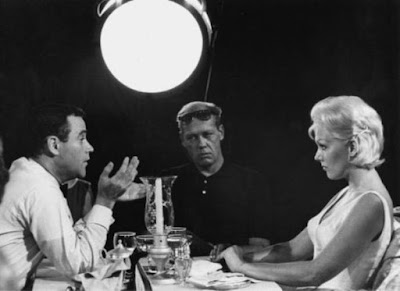
Richard Quine, between stars Jack Lemmon and Kim Novak,
rehearsing a scene from his 1962 film, The Notorious Landlady.


Richard Quine has intrigued me for years. Long before I knew who he was, this film director held sway over me, thanks to his 1964 farce, Sex and the Single Girl, a film I have enjoyed since the late Sixties when it made an appearance on late-night television. Son of an actor, Quine was born in Detroit, Michigan, on November 12, 1920. Six years later his family relocated to Los Angeles, and Quine began work as a child actor on radio. He made his film debut in Cavalcade, which won the Best Picture Oscar of 1933, but left Los Angeles for New York City and Broadway a few years later, making his debut on The Great White Way in the 1939 musical Very Warm for May. The next year Quine was cast in the comedy My Sister Eileen, starring Shirley Booth. The show was a huge success, and it led Quine back to Hollywood when Metro-Goldwyn-Mayer cast him in one of their "kids" musicals, Babes on Broadway, with Mickey Rooney and Judy Garland, in 1941. At MGM, Quine met a promising actress also working at the studio named Susan Peters. The two married in 1943.

December 1941 brought the United States' entry into World War II, and Quine began his service in the US Coast Guard. After the war, MGM dropped his acting contract and, he began to consider a life behind the camera instead of in front of it. It was also around this time that tragedy struck his wife, Susan Peters.

Richard Quine and Susan Peters on their wedding day.
The marriage and their relationship would end after a tragic accident.

Susan Peters had earned a Best Supporting Actress nomination for Random Harvest--her first substantive role--and her career at MGM was off to a promising start. On New Year's Day 1945, however, Quine and Peters were duck hunting when a rifle accidentally discharged, and Peters was shot. The bullet lodged in her spinal cord, and she was paralyzed for the rest of her life. The couple tried to make the best of it: In 1946 they adopted a boy, but ultimately they separated, with Peters charging Quine with cruelty, saying he would not speak to her for days at a time. They divorced in 1948, and Peters died in 1952 from complications stemming from her paralysis as well as depression. At this time in his career, Quine met an aspiring writer, Blake Edwards. The two met on Quine's first directorial effort, 1948's Leather Gloves, when Edwards was a struggling actor cast in the film.They would subsequently collaborate on seven films written by Edwards or co-written by the pair, including Edwards' 1955 directorial debut, Bring Your Smile Along. 

Blake Edwards, with cigar, in the 1960s

Richard Quine's career progressed steadily throughout the 1950s. Highlights included the noir drama, Pushover (1954), his first with muse Kim Novak; the musical remake of My Sister Eileen (1955); and a pair of Judy Holiday vehicles, The Solid Gold Cadillac and Full of Life (both 1956). These were all solid box office winners produced with small budgets. 1957 saw a real breakout winner, military service comedy, Operation Mad Ball. Starring Jack Lemmon in the second of six collaborations with Quine (My Sister Eileen was the first), Operation Mad Ball pushed the comedic boundaries to the late Fifties' limit. The film was such a surprise hit that Columbia Pictures' Harry Cohn entrusted Quine with the adaptation of the Broadway hit, Bell, Book and Candle. Starring Kim Novak and James Stewart fresh off Hitchcock's box office disappointment, Vertigo, with Lemmon in a secondary role, BB&C was a substantial hit for Columbia. With Novak more relaxed and natural under Quine's guidance the studio again paired the director and star for the sudsy, underrated Strangers When We Meet. If Richard Quine is remembered for anything in cinema history it should be for the natural, relaxed sexiness he coaxed out of Kim Novak on screen, something most of her other directors didn't seem capable of.

Quine with star and muse, Kim Novak

Quine's next project was based on a best-selling novel and Broadway play, The World of Suzie Wong. Starring William Holden and newcomer Nancy Kwan, Suzie Wong told the provocative story of architect Holden who chucks everything to go earn his living as an artist in Hong Kong. There he meets prostitute Suzie Wong. Attracted to her yet disturbed by her life, Holden and Kwan's Suzie fall in love, which raise complications to be overcome. The film was a big hit--number six at the nation's theaters.

In 1962, Novak and Lemmon reunited--with Fred Astaire, no less--in Quine's quirky, Hitchcockian, romantic comedy, The Notorious Landlady, about an American, played by Lemmon, who works at the American embassy in London. Novak plays his landlady, who is suspected of killing her husband. While she is put on trial, she is released for lack of evidence (no corpse), so suspicions remain. Meanwhile, Lemmon and Novak fall in love. Response to the film was somewhat lackluster, and the release of The Notorious Landlady also saw the end of the Quine-Novak romance, which appeared to have run its course. 

Quine with third wife, entertainer Fran Jeffries

Quine moved on. In 1964, he directed two more romantic comedies: Paris When It Sizzles, a critical bomb starring William Holden and Audrey Hepburn; and Sex and the Single Girl with a stellar cast of Natalie Wood, Tony Curtis, Henry Fonda, Lauren Bacall, Mel Ferrer (Mr. Audrey Hepburn at the time), and Quine's future wife, Fran Jeffries

Sex and the Single Girl--an entirely fictional comedy based on the groundbreaking nonfiction book of the same name by Helen Gurley Brown--is one of my all-time guilty pleasures. Everything about this movie continues to bring joy to my inner pubescent boy: Natalie Wood's innocently sexy role as psychologist, Dr. Helen Gurley Brown; Tony Curtis's shameless playboy-cum-magazine writer, Bob Weston; Fonda and Bacall's constantly bickering-yet-obsessed couple, Frank and Sylvia Broderick; and Mel Ferrer's obnoxious clinic colleague, Rudy ("Oh, shut up, Rudy!"). Sex and the Single Girl offered about all the sex and innuendo this grade-school boy could hope for when I first saw it in the late Sixties. A precursor to an endless list of imitators, including Sex and the City, the film's plot concerns psychologist Helen Gurley Brown whose book, Sex and the Single Girl, causes a scandal at her clinic and how Curtis tries to expose Helen as a fake (that is, a virgin), while at the same time falling in love with her (who wouldn't?). Quine, by now an old hand at such stuff, crams in some slapstick (Curtis's Bob, pretending to be Fonda's Frank, threatens suicide, falls off a pier and into the ocean, taking Helen, who has arrived to save him, into the water with him; the entire cast, including a beleaguered and/or unbalanced highway patrolman, played by Larry Storch, on a madcap chase through Los Angeles to the airport) as well as an inside joke regarding Curtis's resemblance to Jack Lemmon from that movie in which he dresses as a woman (1959's Some Like It Hot) as Curtis, after taking his suicidal ocean dive goes back to Helen's apartment to dry off and wears her robe (the movie's friskiest scene).


Richard Quine and Jack Lemmon worked together for the last time on 1965's How to Murder Your Wife. This time capsule of a comedy has the quintessential bachelor mentality of its day (i.e., chauvinist by modern standards), yet at the time it was popular enough to land number eleven of the Top Twenty Box Office Hits of 1965. It was also the last substantial hit of Quine's career. Later that year, Quine made an off-beat, risky venture, Synanon. Based on an actual rehab house of the same name, the film (which I haven't seen), released by Columbia Pictures, seems a curiosity in Quine's career.

1967 brought the director his last two real high-profile ventures. Hotel, based on a best-selling novel by Arthur (Airport) Hailey, boasted an all-star cast that included Rod Taylor, Karl Malden, Melvyn Douglas, Merle Oberon,  Richard Conte, and Michael Rennie. Not a great success at the box office--it broke even--the film did lead to a semi-successful Aaron Spelling-produced television series in the 1980s, starring James Brolin and Connie Sellecca. The other film Quine directed that year was the adaptation of the groundbreaking off-Broadway play Oh Dad, Poor Dad, Mamma's Hung You in the Closet and I'm Feeling So Sad. With a cast that included Rosalind Russell, Barbara Harris, Robert Morse, Hugh Griffith, and Jonathan Winters, this film version did not live up to the stage version's expectations. The next couple of years found Quine involved in the less-than-stellar productions, A Talent for Loving  and The Moonshine War, both starring Richard Widmark, who was also at a low point in his career. The films quickly disappeared. It was around this time-1970-that the director's marriage to Fran Jeffries ended, and Quine, with limited film prospects, took several television jobs. From 1972 to 1974, he directed three episodes of the popular Peter Falk series, Columbo, along with other shows. In 1974, Quine directed his first film in four years with the mystery thriller, W, starring supermodel Twiggy. The film came and went with barely a trace.


In 1979, Quine directed his last credited feature, The Prisoner of Zenda, starring Peter Sellers. Two other, better productions preceded Quine's version of Zenda. Despite the presence of Sellers, the film didn't amount to much at the box office, and though it was nice to see Quine's name associated with an A-picture again, it was soon forgotten. Quine started on Sellers' next project, The Fiendish Plot of Fu Manchu, but he was fired while the film was in pre-production. It was the last project Richard Quine was associated with. Depressed and angry with an industry that hadn't allowed him to direct a quality film in nearly a decade, Quine died of a self-inflicted gunshot wound in June 1989. He was 68 years old.

Sources:  Wikipedia
                Kim Novak on Camera by Larry Kleno
                Jack Lemmon, The Pyramid Illustrated History of the Movies by Will Holtzman
                Kirk Douglas, The Pyramid Illustrated History of the Movies by Joseph McBride
                Golden Boy: The Untold Story of William Holden by Bob Thomas